
Trusting Your Ideas Before Anyone Validates Them
Every creative idea begins in a quiet place.

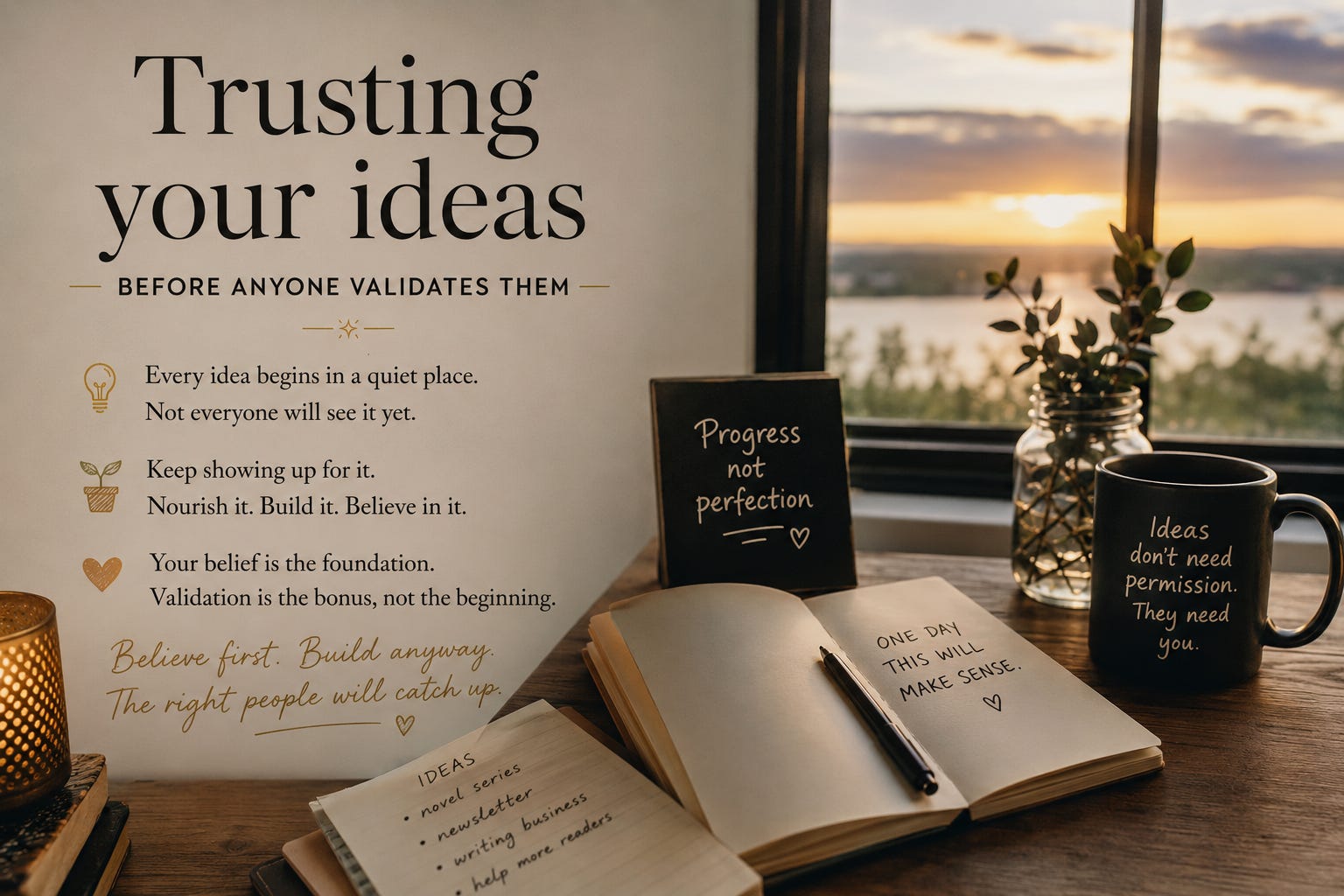
Before the comments, shares, sales, reviews, or congratulations, there is usually just you and a thought that refuses to leave you alone.
Maybe it is an idea for a book.
A new business.
A newsletter no one has subscribed to yet.
A character who keeps talking while you are trying to sleep.
A subject you feel called to write about, even though you are not sure anyone else will understand why it matters.
At that stage, the idea does not look impressive. It has no numbers attached to it. No audience has gathered around it. No one is praising your vision because most people cannot see it yet.
That is when trusting yourself matters most.
Validation Usually Comes Later
We often imagine that confidence comes first.
We think successful people begin their projects knowing they are brilliant, marketable, and destined to work.
Most of the time, they do not.
They begin with curiosity.
They begin with a hunch.
They begin because something inside them says, Try this.
The validation comes after the work has already started.
Someone cannot praise a book you never write. Readers cannot subscribe to a newsletter you never publish. Clients cannot hire you for a service you are too uncertain to offer.
Sometimes we wait for encouragement as though it is permission.
But the beginning of a creative project often requires us to move before anyone else understands what we are building.
Other People Can Only See the Early Version
One reason people may not immediately support your idea is that they are seeing the smallest version of it.
You are imagining the completed book.
They are looking at three unfinished chapters.
You are imagining a thriving newsletter community.
They are looking at your first post with six subscribers.
You are imagining a full creative business.
They are looking at a Canva graphic, a rough website, or a service you have only recently begun promoting.
They are responding to what exists today.
You are working toward what could exist tomorrow.
That does not mean every idea will become exactly what you envisioned. Some ideas need to be adjusted, strengthened, or released. But an idea should not be abandoned simply because other people cannot immediately picture its potential.
They have not spent as much time with the vision as you have.
Silence Is Not Always Rejection
The early stages of sharing your work can feel painfully quiet.
You publish the post.
You announce the project.
You explain the service.
Then almost nothing happens.
No flood of comments. No sudden increase in followers. No immediate proof that you made the right decision.
It is easy to interpret silence as failure.
But silence can mean many things.
People may be watching without responding. They may need to see your work several times before remembering your name. They may appreciate what you created but have no immediate reason to comment, subscribe, or buy.
Sometimes the work is simply too new to have momentum.
A quiet beginning does not predict a quiet future.
You Still Need Discernment
Trusting your ideas does not mean treating every thought as a guaranteed success.
Creative confidence and honest evaluation can coexist.
You can believe in an idea while asking:
Does this solve a real problem?
Is the message clear?
Am I willing to stay with it long enough to improve?
Does this project fit the life and business I am trying to build?
What feedback would help me strengthen it without changing its heart?
The goal is not to ignore useful criticism. The goal is to stop allowing other people’s immediate reactions to determine whether your idea deserves a chance.
Feedback should help shape the work.
It should not automatically silence the person creating it.
Build Evidence Through Action
Sometimes confidence does not arrive through positive thinking.
It arrives through proof.
You finish the chapter.
You publish another newsletter.
You improve your portfolio.
You receive your first inquiry.
You notice that something that once felt difficult now feels familiar.
Each completed step becomes evidence that you can carry the idea farther.
You may not believe in the entire journey yet. Believe enough to take the next step.
Confidence often grows behind you, not in front of you.
You look back and realize you have already done things you once questioned whether you could do.
Stop Asking Everyone to See It
Some ideas become weaker because we expose them to too many opinions too early.
We explain them repeatedly, hoping someone will finally respond with the exact enthusiasm we need.
Instead, we receive questions, doubts, suggestions, and projections based on other people’s experiences.
Not everyone deserves access to an idea while it is still fragile.
Some people are good at encouraging possibilities.
Others only understand completed results.
Protecting an idea does not mean becoming secretive or refusing help. It means being selective about whose feedback you allow to influence the early stages.
Share developing ideas with people who know how to offer wisdom without crushing momentum.
Your Idea Does Not Need to Look Impressive Yet
Beginnings are allowed to look small.
Your first newsletter may not resemble the polished publication you admire.
Your first novel draft may be uneven.
Your first portfolio may contain work you created for yourself because no client has hired you yet.
Your first offer may change after you learn what people actually need.
That is not evidence that the idea was wrong.
It is evidence that the idea is still becoming.
We sometimes compare our beginning to someone else’s established body of work and decide we are already behind.
But every polished platform began with an imperfect first step that someone was willing to take seriously.
Believe Before the Applause
There may come a day when people praise the thing you almost abandoned.
They may call you talented, disciplined, creative, or visionary.
They may assume you always knew the idea would work.
You will remember differently.
You will remember the days when the response was quiet.
You will remember wondering whether the effort mattered.
You will remember continuing without applause.
That private decision—to keep working before anyone validates the work—may be one of the most important parts of your creative life.
Because your ideas need more than public approval.
They need your attention.
Your patience.
Your willingness to develop them.
And sometimes, before anyone else believes in what you are building, they simply need you to believe enough to begin.